One of the big ongoing questions in NBA stats and player valuation is where to set “replacement level”. I believe an empirical approach to determining that level is best. Jeremias Engelmann has produced an outstanding resource in his 12 year average RAPM data. Since so many years are used, it is quite stable; however,...
Read more »
Tags: Adjusted +/-, NBA, Player Ratings, RAPM, Replacement Level, Stat Theory, Statistics, Tableau Charts, Visualization
Posted in NBA Stats | No Comments »
As I prepare to release my first work based on the Adjusted Plus/Minus and derivative methods, I felt it would be wise to write a plain-English review of the state-of-the-art of Adjusted Plus/Minus and its derivatives, or at least what is known in the public domain. What is Plus/Minus? Plus/Minus, at its core, simply...
Read more »
Tags: Adjusted +/-, Player Ratings, RAPM, Stat Theory, Statistics, With-or-Without-You
Posted in NBA Stats | 12 Comments »
That’s right, golf. I’m taking up where Ken Pomeroy left off. A year or two ago, he developed a rating system for golfers–basically, he created a huge regression of all players and all specific rounds at tournaments. Each round was assigned a level of difficulty, and each player was assigned an overall rating. His...
Read more »
Tags: Bayesian Analysis, Golf, Major Championships, PGA, Player Ratings, Stat Theory, Statistics
Posted in Golf | 11 Comments »
Okay, ready for the tournament? I’ve put together some adjustments based on the work I . The theory behind the adjustments may be found on STATS @ MTSU and Dr. Winner @ Florida. Basically, I’m adjusting for teams that raise their game to a higher level against good foes (or vise-versa). For instance, Long...
Read more »
Tags: Bayesian Analysis, NCAA Basketball, NCAA Tournament, Stat Theory, Statistics, Team Ratings
Posted in NCAA Basketball | 3 Comments »
When we get to the NCAA tournament, it seems that inevitably, some teams will raise their game, matching up with the “better” teams, suddenly emerging as a top team. Some teams play well when their opponent is better, and let the foot off the gas when playing East Popcorn St. Those teams tend to...
Read more »
Tags: Bayesian Analysis, NCAA Basketball, NCAA Tournament, Stat Theory, Statistics, Team Ratings
Posted in NCAA Basketball | No Comments »
The Bracket was revealed yesterday. Quick thoughts and long ramblings below: I have two rankings systems: my Bayesian predictive power ratings, which tell how good the teams are, and my DSMRPI ratings, which tell how much they have accomplished. I would put teams in and seed them based on DSMRPI, which looks purely at...
Read more »
Tags: Bayesian Analysis, NCAA Basketball, NCAA Tournament, Stat Theory, Statistics, Team Ratings
Posted in NCAA Basketball | 2 Comments »
In my , I took as the Bayesian prior the overall distribution of NCAA teams. Now, we know more than that–we can create a pretty good projection of how good a team will be based on how good the team has been the previous few years. So let’s do it! I compiled the Pomeroy...
Read more »
Tags: Bayesian Analysis, NCAA Basketball, Stat Theory, Statistics, Team Ratings
Posted in NCAA Basketball | No Comments »
I posted my NCAA Bayesian Ratings and methodology. Today I thought I’d update the numbers quickly and add a new twist. What is the objective in basketball? To win the game! When doing a predictive rating system (like this Bayesian method) or even trying to tell how good teams are over this season (KenPom’s...
Read more »
Tags: Bayesian Analysis, NBA, NCAA Basketball, Stat Theory, Statistics, Team Ratings
Posted in NCAA Basketball | No Comments »
A few days ago, I put up a massive post on . Nathan Walker (the Basketball Distribution) commented that I should apply the system to NCAA basketball, and so I have. Thanks to Ken Pomeroy’s incredible NCAA basketball database, the data was quite easy to obtain. Since he already compiles a fully adjusted efficiency...
Read more »
Tags: Bayesian Analysis, NCAA Basketball, Projections, Stat Theory, Statistics, Team Ratings
Posted in NBA Adjusted Efficiencies, NBA Rankings, NCAA Basketball | 1 Comment »
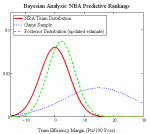
It is fairly easy to construct a retrospective efficiency rating. Take the efficiencies for each game, correct for location and rest, and then solve using an OLS regression for each team’s true efficiency rating. Nice and neat. However, how should a predictive rating work? The best approach would be to adjust for what players...
Read more »
Tags: Bayesian Analysis, Google Motion Charts, NBA, Projections, Stat Theory, Statistics, Team Ratings
Posted in Google Motion Charts, NBA Adjusted Efficiencies, NBA Rankings, NBA Stats | 12 Comments »