Last week, I unveiled a Google Motion Chart that included a large number of advanced stats comparing point guards. This week, we’ll start at the other end: centers. I actually am including players classified as either C or PF/C by BasketballValue, where I got the position information.
Most people feel that the position of center is changing, morphing into something different than it once was. The presence of numerous “centers” that hang around on the perimeter shooting 3’s is an indicator of this phenomenon. Still, there is a defined way a center plays–and to define it, let’s turn to the lovely tool known as K-Means Clustering.
Tom Haberstroh had a series at Hardwood Paroxysm discussing the positional revolution. I commented at the time that a K-Means clustering analysis may be the way to attack the problem of what “positions” there really are in the NBA. Of course, the positional spectrum is really a continuum, but since there are 5 players on the floor, perhaps the 5 most common “roles” could be discerned.
Well, thanks to Dr. Wagner Kamakura at Duke, there is a free K-Means clustering plugin for Excel. I compiled 4 years’ worth of Hoopdata statistics (the shot location data is critical for this analysis) and set to work. I’m not exactly sure what I found. I explored all sorts of clustering options–5, 6, 7, 9, 10 clusters; weighted clusters; different statistics.
Here is a taste of the results, a table of a 5 cluster run, showing the archetype of each cluster. The column “Wt” at the left shows what weight I put on that specific statistic.
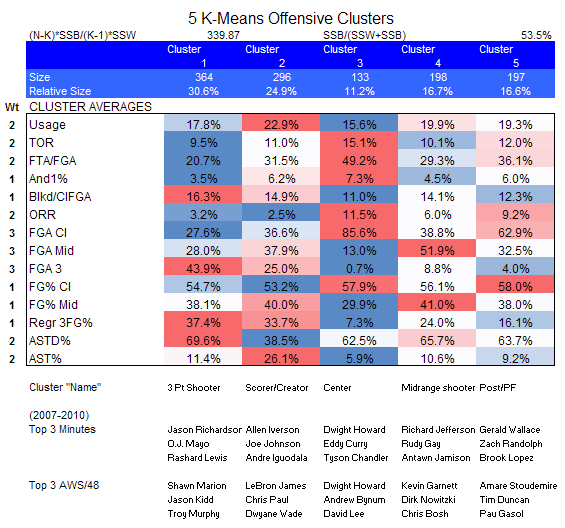
5 K-Means Offensive Clusters
Cool, huh? I don’t know what it means, either. I never thought Jason Kidd and Troy Murphy played the same position.
What is obvious, though, is that there is a well-defined “center” position. The center has extreme values in nearly every statistical category, from AST% to shot location and FG%. And Tim Duncan and Kevin Garnett don’t play center, at least on the offensive end–but David Lee does, or should I say did. Lee was a “Center” only in 2007 but has since switched to cluster 3, “Post/PF”.
Well, to get back to the Center Comparison Chart. To simplify matters, I just used BasketballValue’s positions, so as not to get stuck in the positionality swamp. May I present 61 “Centers or Center/Power Forwards”. Three different clusters from above represented.
Interesting points:
- Centers are pretty average on offense a lot of the time–a lot of their baskets are created by others and they don’t create many themselves, for the most part. No one would dispute that Kevin Love is a really good offensive player, though.
- Dwight Howard can play some D.
- Bargnani is a Center/PF? He doesn’t even get 10% of available rebounds!
- How can the same player be the best rebounder and the worst shot-blocker?
- Tyson Chandler is efficient on offense this year. In that he scores when he shoots. He just isn’t very good at offense otherwise!
- OKC has 3 “centers” but… ouch.
Glossary Table:
| # | Label | Meaning | More Information |
|---|---|---|---|
| 1 | Player | Player name | |
| 2 | Age | Age of player | |
| 3 | Tm | Team of player | |
| 4 | TS% | True Shooting % | see Basketball Reference Glossary |
| 5 | eFG% | Effective Field Goal % | see Basketball Reference Glossary |
| 6 | ORB% | Offensive Rebounding % | see Basketball Reference Glossary |
| 7 | DRB% | Defensive Rebounding % | see Basketball Reference Glossary |
| 8 | TRB% | Total Rebounding % | see Basketball Reference Glossary |
| 9 | AST% | Assist % | see Basketball Reference Glossary |
| 10 | STL% | Steal % | see Basketball Reference Glossary |
| 11 | BLK% | Block % | see Basketball Reference Glossary |
| 12 | TOV% | Turnover % | see Basketball Reference Glossary |
| 13 | USG% | Usage % | see Basketball Reference Glossary |
| 14 | PER | PER | see Basketball Reference Glossary |
| 15 | ORtg | Offensive Rating | see Basketball Reference Glossary |
| 16 | DRtg | Defensive Rating | see Basketball Reference Glossary |
| 17 | OWS | Offensive Win Shares | see Basketball Reference Glossary |
| 18 | DWS | Defensive Win Shares | see Basketball Reference Glossary |
| 19 | WS | Win Shares | see Basketball Reference Glossary |
| 20 | WS/48 | Win Shares/48 minutes | see Basketball Reference Glossary |
| 21 | ASPM | Advanced Statistical Plus/Minus | |
| 22 | O ASPM | Offensive Advanced Statistical Plus/Minus | |
| 23 | D ASPM | Defensive Advanced Statistical Plus/Minus | |
| 24 | OVORP | Offensive Value over Replacement player | |
| 25 | DVORP | Defensive Value over Replacement Player | |
| 26 | VORP | Value over Replacement Player | |
| 27 | VORP-GM | Value over Replacement Player, in games played | |
| 28 | MPG | Minutes per Game |
To be clear, what is “AWS/48” mentioned in the chart? WS48 or something else?
What are the distributions of traditional position labels assigned to players for each cluster?
Alternative Win Score per 48 minutes. It’s a Hoopdata stat.
I’ll explore clustering more some other time, and how it relates to “traditional” positions.
I’m not sure, and I can’t even find it on the chart. Tough game today, but its been even tougher watching the DT comments devolve into stupid arguments and extremism. I don’t know about you guys (Crow and Daniel), but its getting pretty overwhelming at times, and I worry one of my favorite places on the internet is fast declining.
oh see it now…
AWS/48 was used as a generic all-in-one stat for the K-Means clustering “example players”.
I avoid Daily Thunder during games. And yes, the quality of commenting has declined. Royce has hinted at some sort of additional moderation of the comments, but it’s really hard to deal with negativity and backbiting.
Anybody think I should add contract status/contract value to the Google motion charts?
More options are usually better.
If you found an Adjusted +/- dataset you were comfortable to add that would be another good option to have.
I thought it was probably Alternative Win Score per 48 minutes but prefer to be sure and not everyone else would necessarily know it.